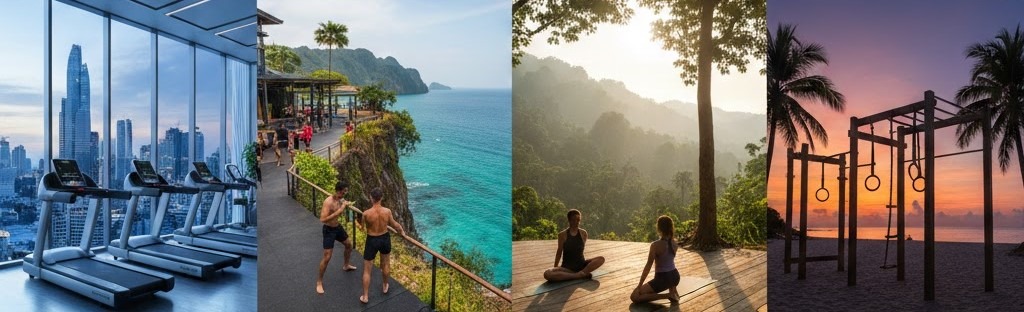
Comparing Gym Programs in Bangkok, Phuket, Chiang Mai, and Koh Phangan
The fitness environment in Thailand is not just according to the training philosophy but also according to the geography, the way of life, and the culture of a community. Although the standards of gyms in the country are high, the experience and structure of the program differ considerably depending on the location.
This knowledge of differences would enable long-stay visitors, expats, and fitness travelers to select programs that would support their objectives.
Bangkok: Performance-Driven and Time-Efficient
The gym programs in Bangkok are a product of the city being fast and an urban environment. The emphasis here is on efficiency, measured outcomes, and cutting-edge equipment. The programs usually focus on strength training, functional fitness, HIIT, and corrective exercise, which are aimed toward professionals who have work-training balancing.
There are numerous sports gyms in Bangkok that make use of assessment-based data, wearable apparel, and progress tracking. Group classes are orderly and time-constrained, hence appropriate to those who like to follow structured time frames and performance outcomes.
Best: Busy workaholics, super strength trainees, data junkies.
Koh Phangan: Boutique Fitness and Lifestyle Integration
Koh Phangan gym is reputed to provide high-quality gyms of the boutique type, which mix fitness, luxury, and relaxation. The programs are usually semi- private or individual, emphasizing individual coaching, low-impact strength training, and functional movement.
Training routines are not very strict and are often combined with spa recovery, yoga, and outdoor work. Instead of an emphasis on volume, the programs are centered on joint health, posture, and vitality.
Best: Use on, One-on-one coaching, training, low-impact training, lifestyle-oriented training.
Chiang Mai: Sustainable and Wellness-Centered Training
The culture of the gym in Chiang Mai focuses on long-term health, mobility, and balance. Here, programs are not so intensive but very sustainable, and they usually include the elements of strength training with yoga, mobility exercises, and mindfulness exercises.
Digital nomads and long-stay visitors in the company of many gyms are also interested in finding a non-burnout and consistent company. Smaller classes and personalized programming are standard, and this enables the trainers to emphasise on form, the prevention of injury, and recovery.
Best for: Entry-level users, older people, telecommuters, and fitness enthusiasts.
Phuket: Transformation and Outdoor Integration
Fitness retreats, body transformation, and Muay Thai camps are internationally known activities in Phuket. Body workouts here are usually a mix of indoor training sessions and a combined body training and conditioning outdoor and beach workouts.
They usually have programs that are done once a week or once a month, which involve nutrition information, recovery, and lifestyle coaching. The slower speed promotes compliance, the environment stimulates the loss of fats, heart health, and the clarity of the mind.
Best: Fat burning, all-round body change, stamina building, fitness holidays.
Key Differences in Program Design Across Locations
The main difference is the intensity of training, the training framework, and the integration of training into lifestyle. The priorities of Bangkok are performance and efficiency, Phuket transformation and immersion, Chiang Mai supports sustainability and balance, and Koh Phangan personalization and recovery.
These variations enable the user to coordinate their fitness programs with their physical targets as well as their daily activities; the consideration needed by long-stay visitors, sports visa in Thailand, and DTV visa employees.
Thailand offers its performance-centered urban gyms and well dollar-based islands as well as retreats that are flexibly oriented towards both short- and long-term needs of both the performance and health-related programs.
Post a comment