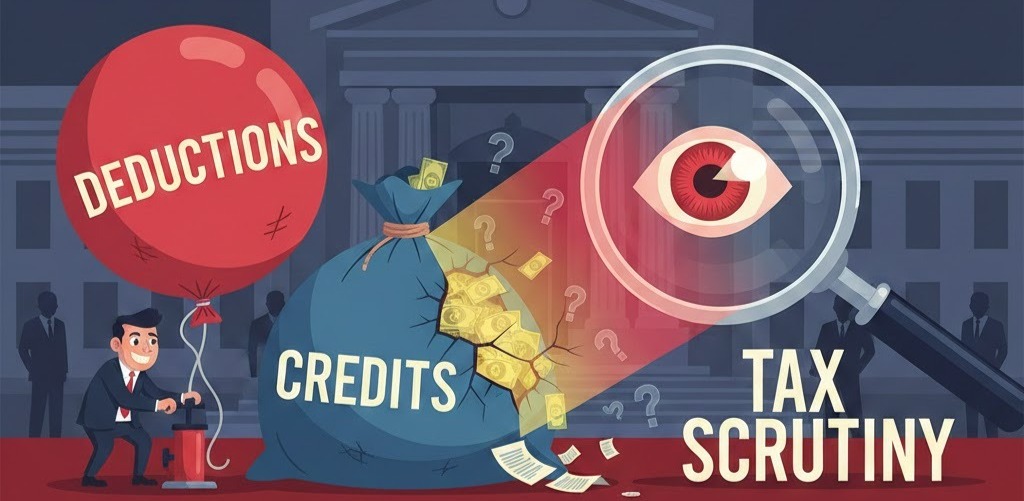
Why Do Inflated Deductions and Credits Often Trigger Tax Scrutiny?
Arguing to have deductions and credits is not illegal to reduce tax liability. But when inflated or unjustified, they normally call instant attention to the IRS. These questions are the reasons why overstated claims are warning bells and how such claims may result in severe taxation consequences about.
What Are Considered Inflated Deductions or Credits?
An overstatement of expenses or claims of credits the taxpayer does not qualify for, or inflated figures, which are overstated to figure out his taxable income, are examples of inflated deductions or credits.
The examples are usually exaggerated charitable contributions, inflated business costs, inappropriate dependency credits, or inflated education and energy credits. Experienced IRS tax experts (former IRS tax agents, former auditors, and experienced EDD audit lawyers) who can help with business deductions.
Why Does the IRS Closely Monitor Deductions and Credits?
Deductions and credits cause a direct decrease in the amount of tax revenue, and thus, they are one of the main subjects of IRS compliance programs. To determine the returns that are not in the normal range, the IRS considers historical data and statistical norms. A return that takes abnormally high benefits in relation to the level of income or industry benchmarks frequently inspires suspicion.
How Does the IRS Detect Inflated Claims?
The IRS is dependent on automatic systems where the returns are compared against those of other similar taxpayers. There are also inconsistencies in information that match up among employers, banks, charities, and third parties. In case the deductions or credits that were reported cannot be validated by documentation or by third-party data, the return may be marked to be reviewed or audited.
What Happens During an IRS Review or Audit?
After flagging, the IRS might demand documents to provide proof of the deductions or credits claimed. In the event that the taxpayer fails to supply sufficient proof, the IRS may disallow the claims, recompute the amount of tax to pay, and impose more penalties and interest. In severe instances, auditing can go back to previous fiscal years.
When Do Inflated Claims Lead to Penalties Instead of Corrections?
Accuracy-related penalties can be imposed in case the IRS concludes that it was negligent or ignored tax regulations that were overstated. Such penalties can be as much as 20 percent of the underpayment of tax. The occurrence of over-statements or large numbers of repetitions raises the risk level of more severe financial implications.
Can Inflated Deductions or Credits Result in Criminal Charges?
Yes. IRS can use criminal prosecutions when exaggerated statements are also considered deliberate and not accidental. The false representation of receipts, the misappropriate assertion of ineligible credits, or systematic exaggeration of expenses can also be defined as willful conduct. Some of the criminal charges may include the filing of a false return or tax fraud.
Does Intent Matter in IRS Enforcement Actions?
Intent plays a critical role. When such errors are made honestly, such cases would be handled as civil ones, but lying intentionally can result in criminal charges. Nonetheless, the IRS can suggest intent on the basis of patterns, lapses in documentation, or previous warnings concerning the same in the case that the taxpayer claims ignorance. Experienced IRS tax experts (former IRS tax agents, former auditors, and experienced payroll tax audit lawyers) can take action against IRS enforcement.
Can Taxpayers Correct Inflated Claims Before Facing Charges?
Yes. Until the IRS begins to enforce the overstated deductions or credits, taxpayers are permitted to submit amended returns to rectify those deductions or credits. Voluntary corrections can help minimize punishment and decrease the chances of criminal inquiring by a long margin. Time is of the essence- it is too late to make any decision after the IRS makes contact with the taxpayer.
Large deductions and credits often cause a tax audit as they corrupt the taxable income and put compliance regimes at a disadvantage.
Post a comment